
No East Hartford Mugshot Gallery Was Found
Start with the plain truth. No official East Hartford County jail mugshot gallery exists. No booking-photo roster, no recent-bookings photo feed, and no jail roster with pictures was located for this town. The East Hartford Police Department is the local arresting and records agency. It is not a county sheriff, and Connecticut does not run county jails.
This surprises many people. In 1968 Connecticut folded all county jails and state prisons into one Department of Correction. There is no county sheriff inmate roster to host photos, and the town police do not publish a public mugshot site. Custody after arrest moves into the state system, where the lookup is a text search, not a photo wall.
So why do people keep searching for these photos? Booking photos are real records. State law requires them for many arrests, which means an image often exists somewhere in the file. What does not exist is a free, browsable East Hartford photo page. The route to a booking photo runs through a records request, not a search box. The custody side of that story sits on the jail inmate records page.
Note: Treat any website that claims to show an East Hartford mugshot gallery with caution, because no official town or state photo roster was located in the research.
What the East Hartford Arrest Log Publishes Instead
The closest public document is the East Hartford Police Department Weekly Arrest Report. The department posts a Weekly Arrest Report and Quarterly Part 1 Crimes set as a PDF. The inspected Adult Arrest Log Press file covered the dates from April 26, 2026 through May 2, 2026 and was run on May 5, 2026. It is a periodic list, not a live roster, and it shows no photos.
Read it for identifiers, not for pictures. Each entry names the person, gives an address, and lists race, sex, and age as of the arrest date. It carries an incident number, an arrest date and time, a court date and time, the statute or charge code, the charge description, and the count. Those fields help you make a clean records request later.
What the log leaves out matters just as much. There is no booking photo. There is no bond amount, no custody status, no release date, no housing location, and no booking number. The table below maps what the weekly log shows against what it omits, with the photo field absent by design.
| Field | What It Shows |
|---|---|
| Booking photo | Absent. The arrest log publishes no mugshot or booking photo at all. |
| Name | Surname with given names, shown for each arrestee. |
| Address | Street, city, state, and ZIP fragment for the person listed. |
| Race, sex, age | Race as a single word, plus sex and age as of the arrest date. |
| Incident number | The police incident number tied to the arrest report. |
| Arrest date and time | Date and time of the arrest. |
| Court date and time | Scheduled court date and time, often listed near 9:00 am. |
| Charges and count | Statute or code, an abbreviated charge description, and the count. |
| Bond, status, housing | Omitted. No bond, custody status, release date, or housing unit appears. |
The log is a police arrest publication, not a jail population list. A name on it does not mean the person is still held, and an empty week does not prove no arrest occurred. The list is weekly and may be updated or superseded.
Connecticut Arrest-Record Law
Connecticut law does make the record of an arrest public, within limits. The Freedom of Information Act, or FOIA, is the open-records law that gives the public a right to inspect and copy agency records unless an exemption applies. FOIA does not put every record online. It lets you request records from the agency that keeps them.
The Freedom of Information Commission, the state body that interprets FOIA, defines the "record of the arrest" you can ask for. It includes the arrestee's name, race, and address, the date, time, and place of the arrest, and the offense. Depending on whether the arrest used a warrant, it also covers the warrant application or affidavit, or the official arrest, incident, or similar report. That definition is what an FOIA request leans on.
The state page for this rule explains both the public side and the limits. To see the source for the arrest-record rule, view the Connecticut FOIC page on the record of arrest.
The image below comes straight from that official source.
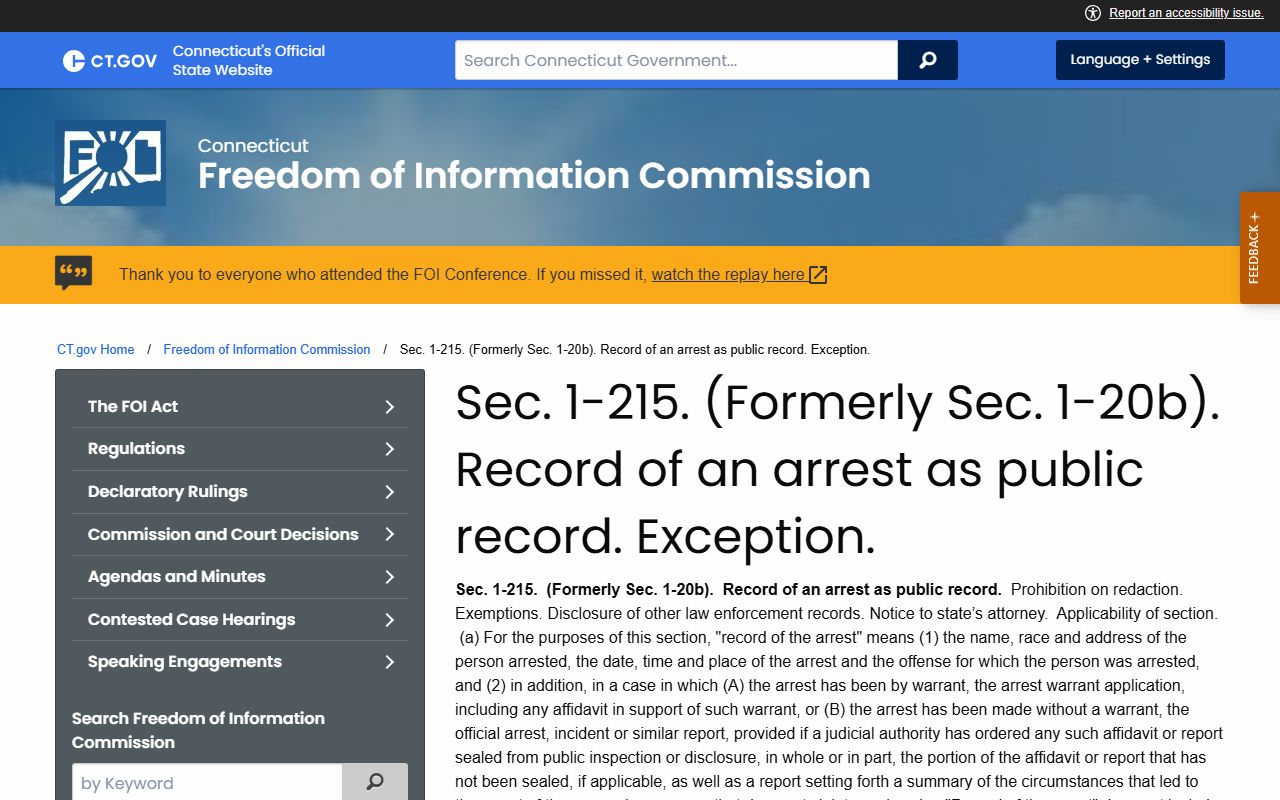
That page shows how the state frames an arrest record as public while reserving grounds to redact parts of it. The core statute behind it, with the public-record rule and the exceptions, is covered in the callout below.
Key statutes for East Hartford booking photos:
Connecticut General Statutes § 1-215 - Makes the record of an arrest public and addresses police records that document or depict arrest and custody during a pending prosecution, subject to FOIA limits.
Connecticut General Statutes § 29-12 - Requires fingerprints, photographs, and physical descriptions for covered arrests and sends them to the State Police Bureau of Identification.
Connecticut General Statutes § 29-15 - Provides for the return or destruction of fingerprints, photographs, and identification data after qualifying nonconviction outcomes.
Connecticut General Statutes § 54-142a - The main erasure statute that removes qualifying criminal records from public view after dismissals, acquittals, pardons, and qualifying nolles.
Booking Photos and Fingerprints Under § 29-12
A booking photo starts at intake. Booking, also called intake, is the administrative processing that follows an arrest. It covers identity, charges, property, fingerprints, photographs where required, and the custody decision. The photograph step is where a mugshot is created.
Connecticut law requires that step for many arrests. Section 29-12 requires fingerprints, photographs, and physical descriptions for covered arrested persons, and it sends that material to the State Police Bureau of Identification. This is why a booking photo for an East Hartford arrest may exist even though no public photo gallery does. The image lives inside an agency record, not on a website.
The distinction is the whole point. The law backs the existence of the photo. It does not create a public mugshot site. Access to that photo depends on who holds the record, whether an exemption applies, and whether erasure or destruction rules have already removed it.
Note: A required booking photo is not the same as a published one, because the statute creates the record while FOIA and erasure rules decide who may see it.
Requesting a Booking Photo from EHPD
If you want an East Hartford booking photo, the local route runs through the police Records Division. The official police-report instructions say to come to the Police Department with a case number or the date and time of the incident. The same counter handles arrest reports and other records the weekly PDF does not show.
The hours are specific and worth noting before you travel. Records is open Monday from 10:00 am to 4:00 pm and Tuesday through Friday from 9:30 am to 4:00 pm. It is closed on weekends and legal holidays. Each copied page costs 50 cents. For questions, call (860) 528-4401 and ask for the Records Department.
The department spells out its report-request process on its own help page, shown below from the East Hartford police report request page.
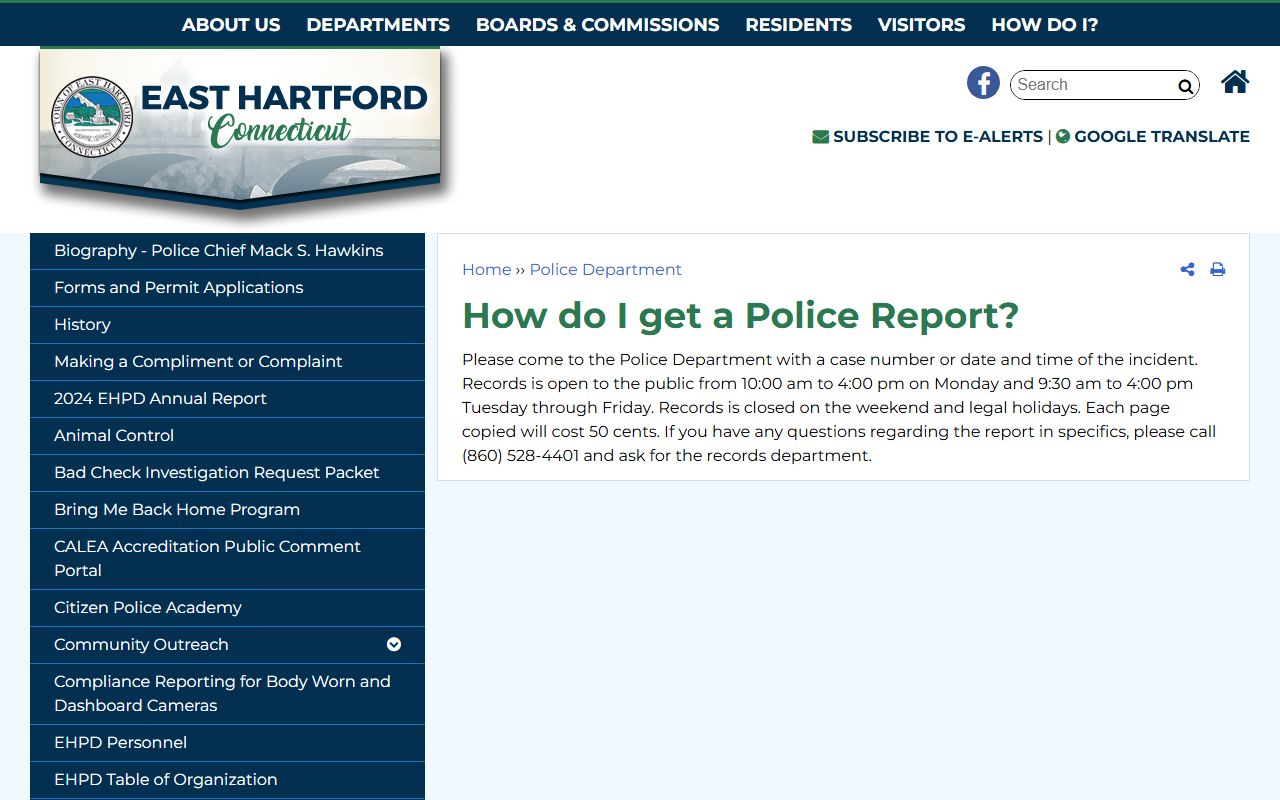
That page describes coming to the department and calling Records. It does not describe a full online portal for arrest or booking records, so plan for an in-person or phone request rather than a download.
The steps below walk through the full path, from pulling identifiers off the arrest log to asking the right agency for the photo.
- Check the EHPD weekly arrest log first for the incident number, arrest date and time, and charges. It carries no photo, but it gives the identifiers a request needs.
- Contact EHPD Records at 31 School St with the case number or incident date and time. Use the listed hours, expect a 50 cent per-page copy fee, and call (860) 528-4401 to reach Records.
- File a Connecticut FOIA request with the agency that holds the record. There is no universal request form, so describe the record as specifically as you can.
- If the person is in state custody, use the CT DOC inmate search for the current location, then contact the DOC Public Information Office for offender information not posted online.
- If federal or immigration custody is involved, use the federal channels instead, because those agencies do not run a public mugshot gallery.
When East Hartford Arrest Photos May Be Withheld
A public arrest record is not an open file with no limits. The Freedom of Information Commission lists material that falls outside the public record of arrest. Erased records, juvenile records, and confidential investigative material are not part of what you can demand. Those categories sit beyond FOIA reach.
The agency may also redact parts of an otherwise public record. The FOIC page names grounds for redaction: the identities of witnesses, information that could identify a protected victim, details that may prejudice a pending prosecution or a prospective law enforcement action, and sealed material. A booking photo request can be trimmed or refused on these grounds when they apply.
What is public and what is not: The record of arrest, meaning the name, address, date, time, place, and offense, is public under Connecticut law. A booking photo is a separate record you must request, and it may be exempt, redacted, or already erased. No online East Hartford mugshot gallery exists, so there is no photo roster to browse.
The result is a case-by-case answer. Some requests return a photo. Others come back redacted or denied because an exemption fits. The standard is the record and the law, not a promise of a picture.
Erasure and Photo Return or Destruction
Connecticut gives a way to clear qualifying records. Erasure is the state process that removes qualifying criminal records from public view. The main erasure statute is Section 54-142a. It applies after outcomes such as a dismissal, an acquittal, certain nolles, and pardons. A nolle is a prosecutor's decision to drop a charge, and display or erasure timing rules can follow it.
Photos and fingerprints have their own cleanup rule. Section 29-15 provides for the return or destruction of fingerprints, photographs, physical descriptions, and identification data after qualifying nonconviction outcomes. So when a case ends the right way, the booking photo can be returned or destroyed rather than kept.
This is the honest version of "mugshot removal." There is no public East Hartford photo site to scrub, and the research found no official town policy promising to pull a photo off a website. The real lever is the court outcome and the statutory cleanup that follows it. Erasure tracks the case result, which is why the court records after a jail arrest page matters for anyone trying to clear a record.
Note: Steer clear of commercial sites that charge to remove a mugshot, because the lawful Connecticut route is the court outcome plus the statutory return or destruction of the photo.
Who to Ask for a Booking Photo
Match the request to the agency that holds the record. Three different offices may be involved, depending on where the person is in the process. Asking the wrong one wastes time and may return nothing.
For a local arrest, EHPD Records is the source. It keeps the police reports and arrest records and runs the weekly arrest log. For someone in state custody, the Connecticut Department of Correction is the agency. Its inmate search shows the custody location, and its Public Information Office handles offender information not posted online. The DOC locator could not be inspected during the research because the portal blocked automated access, so whether it displays a photo at all could not be confirmed.
The list below sorts the channels by who actually holds the record.
- East Hartford Police Department Records, for local arrest reports and booking records, at 31 School St with a case number or incident date and time.
- Connecticut Department of Correction, for custody location through its inmate search and offender details through the DOC Public Information Office.
- Federal agencies, including the Bureau of Prisons and the U.S. Marshals Service, which do not publish a public mugshot gallery.
Keep the custody types straight. Pretrial people held by the state and sentenced people both appear in the DOC system, while federal and immigration detainees do not. A failed DOC search does not rule out federal or immigration custody.
Why Federal Mugshots Are Different
Federal custody runs on its own track, fully apart from East Hartford police and the state DOC. The Bureau of Prisons and the U.S. Marshals Service generally do not publish a public mugshot gallery like the commercial sites people picture. There is no federal photo roster to browse for an East Hartford arrestee.
The federal lookups return text, not pictures. The BOP inmate locator covers federal inmates from 1982 to the present, and its results list a name, register number, age, race, sex, release date, and location. No booking photo appears in those results. For federal court records, PACER and the U.S. District Court are the path, and for marshal custody questions the District of Connecticut office is the contact.
Immigration custody is separate again. The Connecticut Department of Correction does not include people held on behalf of federal immigration authorities in its database. For an immigration detainee, the federal detainee locator gives a custody location, not a mugshot. The takeaway is steady across all of these: request a specific record from the agency that has it, and do not expect a federal photo gallery to exist.