
Arrest Charges vs Court Charges in East Hartford
An arrest and a court case are two different things. East Hartford Police make the arrest and write down booking charges. Those charges land in the department's weekly arrest log. The court record begins later, when a State's Attorney reviews the case and files the formal charges. Connecticut does not use county district attorneys. Its prosecutors are State's Attorneys in the Division of Criminal Justice. The charges they file can match the police charges, or they can change.
This split matters for anyone tracking court records after an arrest. The booking charge is a police accusation at the scene. The court charge is what the prosecutor chose to pursue. A prosecutor may add a count, drop one, reduce a felony to a misdemeanor, or swap the statute cited. Connecticut also does not route routine cases through a grand jury. Charges come from the prosecutor by a written information or complaint, not by indictment.
The booking side and the court side live in separate systems. Booking detail and custody status appear on the jail inmate records side, and any booking photo question is covered on the jail roster mugshots page. The court record itself lives in the Connecticut Judicial Branch case lookup. That is where the filed charges, the docket number, and the charge status show up after the clerk enters the case.
How to Find East Hartford Court Records After an Arrest
Court records after an arrest are searched through the Connecticut Judicial Branch, not a county clerk. The Criminal and Motor Vehicle Case Look-up hub is the front door. It links to a pending case search for open matters and a conviction search for closed ones. The lookup is free, needs no login, and covers cases statewide. Arrest and booking detail stays on the police side, so the court lookup is the tool for the charges a prosecutor actually filed.
To find the case for an East Hartford arrest, follow these steps.
- Open the Judicial Branch criminal and motor-vehicle lookup hub and choose the pending case search.
- Search by the defendant's last name, or by the docket number if you already have it.
- Open the matching case and read the charge list the prosecutor filed.
- Check each charge's statute code, type, and current status, then note the court location and dates.
A look at the hub helps before you start. The Judicial Branch criminal lookup page lays out the search choices and the public-display rules.
The hub layout below shows how the branch splits open cases from closed ones.
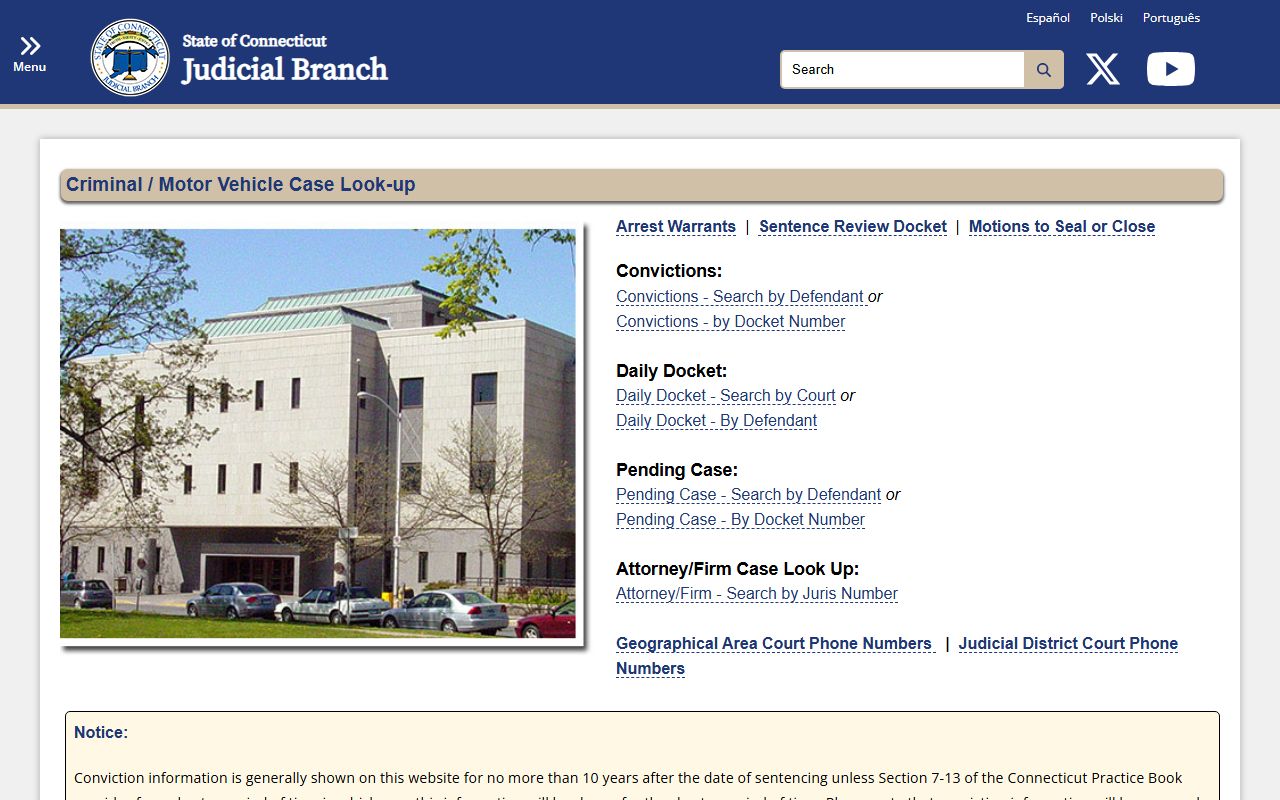
That hub is the launch point for every court-record search after an East Hartford arrest, and each link below it opens a separate search form. Pending and conviction records sit behind different forms because the display rules differ.
Note: court lookup pages carry an accuracy timestamp and are refreshed in batches, so a same-day arrest may not appear in the case search right away.
How an Arrest Becomes a Court Record
The path from arrest to court record runs in a clear order. Police arrest and book the person. The State's Attorney reviews the file and decides the formal charges. The clerk enters the case, and the charges appear in the Judicial Branch lookup as the court record. Each stage can change the charges, which is why the police list and the court list may not match.
The table compares what each stage produces and where it shows up.
| Stage | Who Acts | What the Record Shows |
|---|---|---|
| Police arrest charge | East Hartford Police | Booking charges in the weekly arrest log; an accusation at the scene, not the court case. |
| Formal court charge | Hartford State's Attorney | The charges the prosecutor files by information or complaint; these may add to, reduce, or replace the police charges. |
| Disposition | Court | The final outcome on each charge, such as dismissed, nolled, or convicted, shown under display rules. |
Connecticut frames this without a routine grand jury step. A prosecutor files an information or complaint to start the criminal case. The arrest log and the court record are still two views of the same person, just at two stages. Read the court record for the charges that count.
East Hartford Court Routing to GA 12 Manchester
East Hartford has no courthouse of its own. Lower-level criminal and motor-vehicle cases route to Geographical Area 12 in Manchester. A GA court is the Superior Court level that handles less serious matters, such as misdemeanors, infractions, and lower-grade felonies. GA 12 serves East Hartford, Glastonbury, Manchester, Marlborough, and South Windsor. Its address is 410 Center Street, Manchester, CT 06040, and the Chief Clerk's line is (860) 647-1091.
When you run the pending case search, the court location for many East Hartford matters will read Manchester GA 12. The official GA 12 Manchester page confirms East Hartford as one of the towns it serves. Hours run 9:00 am to 5:00 pm, with doors open at 8:30 am. Public and juror parking is available at the courthouse, CT Transit serves the area, and wheelchair access is through the front door.
Hartford-area courts also show up in East Hartford records. Hartford GA 14 at 101 Lafayette Street appears in some related matters and lists a Chief Clerk at (860) 566-1630 and Bail Services at (860) 566-4966. A reader checking court records after an arrest should not assume one court covers everything. The case location is shown on the record itself, so trust the docket rather than a guess.
Hartford Judicial District for Serious Felonies
Serious felony matters do not stay in the GA court. They move to the Hartford Judicial District and its Part A docket. Part A is the Superior Court track for the most serious crimes, mainly class A and class B felony offenses. The Hartford Judicial District includes East Hartford among its many towns. So a major East Hartford case can show a Hartford court location even though minor cases route to Manchester.
This routing affects custody as well as the court record. If an East Hartford defendant stays in custody, the key Hartford-area pretrial facility is Hartford Correctional Center. The court case may still be listed under Manchester GA 12 or the Hartford Judicial District. The court record and the custody record are separate lookups that can name different places for the same person.
Note: a single arrest can produce both a GA-level matter and a Part A matter, so check more than one court location when records do not appear under the first one.
Pending Case Search by Defendant
The pending case search by defendant is the most common way to find court records after an arrest when you do not have a docket number. It searches open criminal and motor-vehicle cases by name. The last name is the only required field, entered as a begins-with search. The other fields narrow the results. The form is free and needs no account.
The fields on the pending case by defendant search are listed below.
| Field | Type | Required | Notes |
|---|---|---|---|
| Last Name (begins with) | Text | Yes | Up to 60 characters; matches names that start with what you type. |
| First Initial | Text | No | One character to narrow common last names. |
| Birth Year | Text | No | Four digits to filter by age. |
| Year Range + or - | Text | No | One digit; widens the birth-year filter. |
| Court Location | Dropdown | No | Statewide list; East Hartford options include Manchester GA 12, Hartford GA 14, Hartford Community Court, and Hartford JD. |
| Category Type | Dropdown | No | Blank, Criminal, Motor Vehicle, or Referred for MV/Boat License/Reg Suspension. |
| Search | Button | n/a | Submits the search. |
The defendant search form looks like the screen below.
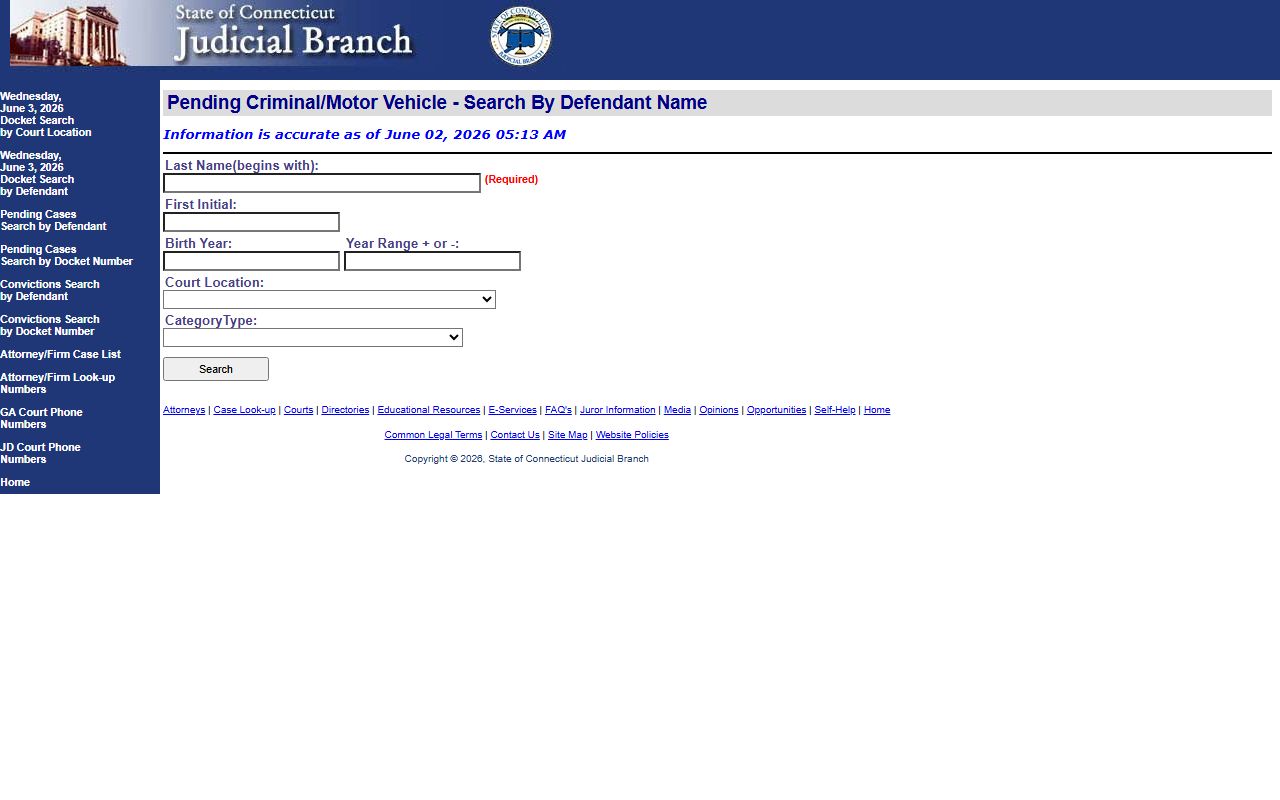
Set the court location to a Manchester or Hartford option to focus the results on East Hartford-area arrests. Leave it blank to search the whole state when you are unsure where the case landed.
Pending Case Search by Docket Number
When you already hold a docket number, the docket search is faster and more exact than a name search. A docket number is the court's case label, built from a court code, a case type, a year, a number, and a suffix. Every field is required because the search builds the full docket from your entries. This avoids the long result lists a common last name can produce.
The pending case by docket number search uses these fields.
| Field | Type | Required | Notes |
|---|---|---|---|
| GA/JD | Dropdown | Yes | Court code; East Hartford-relevant codes include H12M, H14C, H14H, and HHD. |
| Type | Dropdown | Yes | CR for criminal, MV for motor vehicle, CI, or MI. |
| Year | Text | Yes | Two digits. |
| Number | Text | Yes | Up to 7 digits. |
| Suffix | Dropdown | Yes | S, T, A, or a digit 0 through 9. |
| Search | Button | n/a | Submits the search. |
The court code tells you a lot at a glance. H12M points to Manchester GA 12, while the H14 and HHD codes point to Hartford-area courts. Match the code to where the East Hartford case routed. If you do not have a docket number, fall back to the defendant search and read the docket off the case you find.
Conviction Search Limits and What the Court Record Shows
A separate search covers convictions rather than open cases. The conviction search by defendant uses fields much like the pending search, including last name, first initial, birth year, court location, and category. It returns closed criminal and motor-vehicle matters. The display is limited, though, which is the part most readers miss. Not every old conviction stays online.
The conviction search by defendant follows the Judicial Branch display rules. Conviction information generally shows for no more than 10 years after sentencing, unless Practice Book section 7-13 sets a shorter period. The record is removed about one month before that display period ends. Youthful offender, juvenile, infraction, and certain violation matters are not shown the same way. Criminal-history information can also change daily because of erasures, corrections, and pardons.
The conviction search screen is shown below.
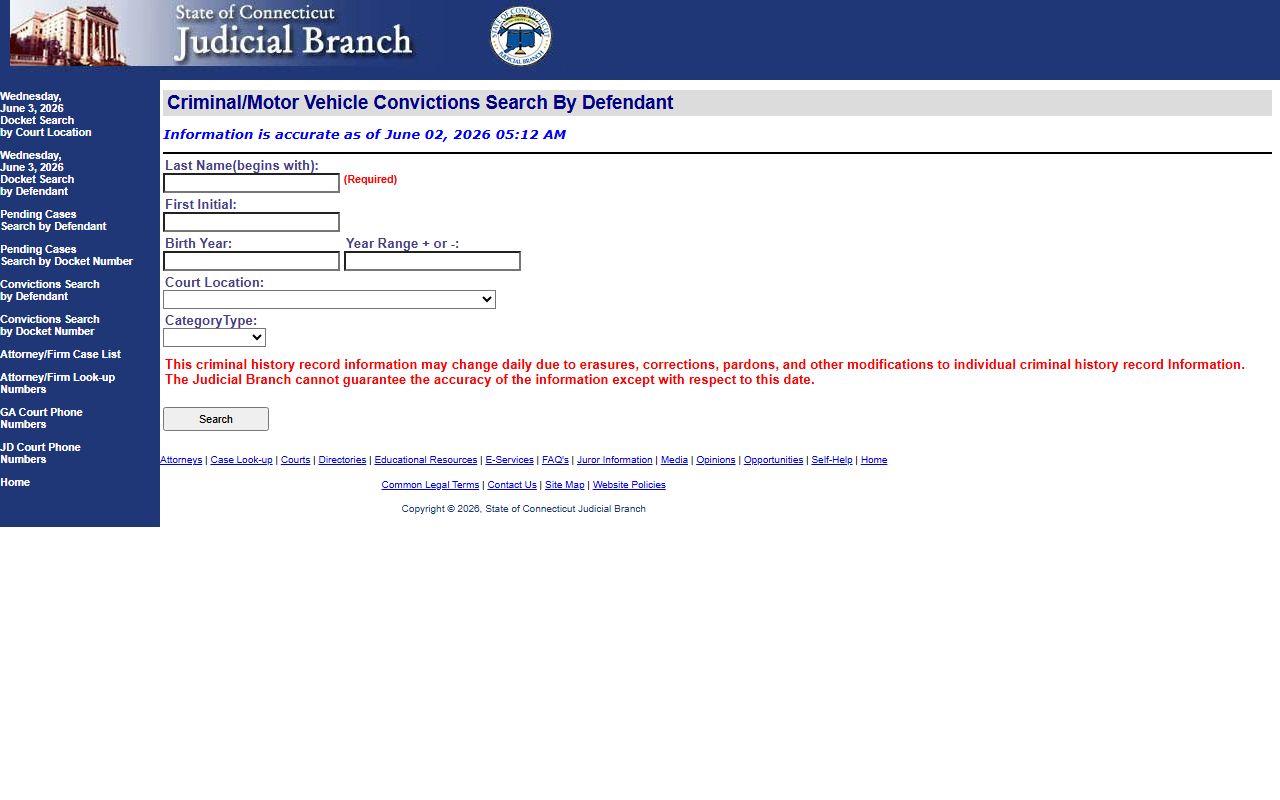
Because of the 10-year window, a clear conviction search does not prove a person was never convicted. Older convictions may have dropped off the public display while the underlying record still exists with the court.
Charge Status in the Court Record
Charges shift as a case moves through court. The charge list on the record carries a status that tells you where each count stands. Booking charges on the police arrest log can differ from the charges the prosecutor finally files, so the status field on the court record is what matters. A few of these terms are legal shorthand worth defining.
| Status | What It Means |
|---|---|
| Pending | The charge is open and the case has not yet been decided. |
| Amended / Substituted | The prosecutor changed the charge, reduced it, added a count, or swapped the statute cited. |
| Dismissed | The court ended the charge without a conviction. |
| Nolle Prosequi | The prosecutor chose not to pursue the charge for now; a Latin term meaning "unwilling to prosecute," and erasure timing rules may apply later. |
| Convicted | The charge ended in a guilty plea or a guilty finding. |
Two of these terms confuse readers most. A dismissal ends a charge cleanly, while a nolle pauses it and can lead to erasure after a set period. Neither is a conviction. Read each count separately, because one case can hold a dismissed charge, a nolled charge, and a conviction all at once.
Bail and First Appearance After an Arrest
Bond decisions start right after an East Hartford arrest and tie directly to the early court record. Police may set bail at the time of arrest. If the person cannot post the police-set bond, police must notify Bail Staff. The Judicial Branch Pretrial Services unit then interviews the person and may raise or lower the amount or recommend conditions. Arraignment, the first court appearance, is where a judge addresses charges, bail, and release conditions.
Connecticut law sets the order of release options. Under CGS section 54-63d, when police report that an arrested person has not posted bail, a bail commissioner or IAR specialist must promptly interview the person and order the first sufficient condition. Under CGS section 54-64a, the court at first appearance does the same, starting from a written promise to appear. Under CGS section 54-66a, a bond automatically terminates when events such as dismissal, nolle, acquittal, or sentencing occur. The table breaks down the common release types.
| Release Type | How It Works |
|---|---|
| Promise to appear | Release with no money; the defendant must come back to court. Often the first sufficient condition. |
| Nonfinancial conditions | No upfront money, but conditions such as supervision, no-contact, or testing may apply. |
| Bond without surety | The defendant signs a bond obligation without a bondsman; money can be owed if conditions are broken. |
| Bond with surety | A money-backed bond, often through a Connecticut-licensed bondsperson or a cash-equivalent posting. |
| Cash / 10% option | The bail FAQ notes full cash, a ten-percent cash option, and licensed bondspersons; the automatic 10% cash option applies to bail of $20,000 or less unless an exception applies. |
| No-bond hold | Not a routine release path; may involve warrants, detainers, or a judicial order, and one bond may not clear all holds. |
The Judicial Branch bail FAQ explains police-set bail, the bail-staff review, and where a bond can be posted. The page below shows that guidance.
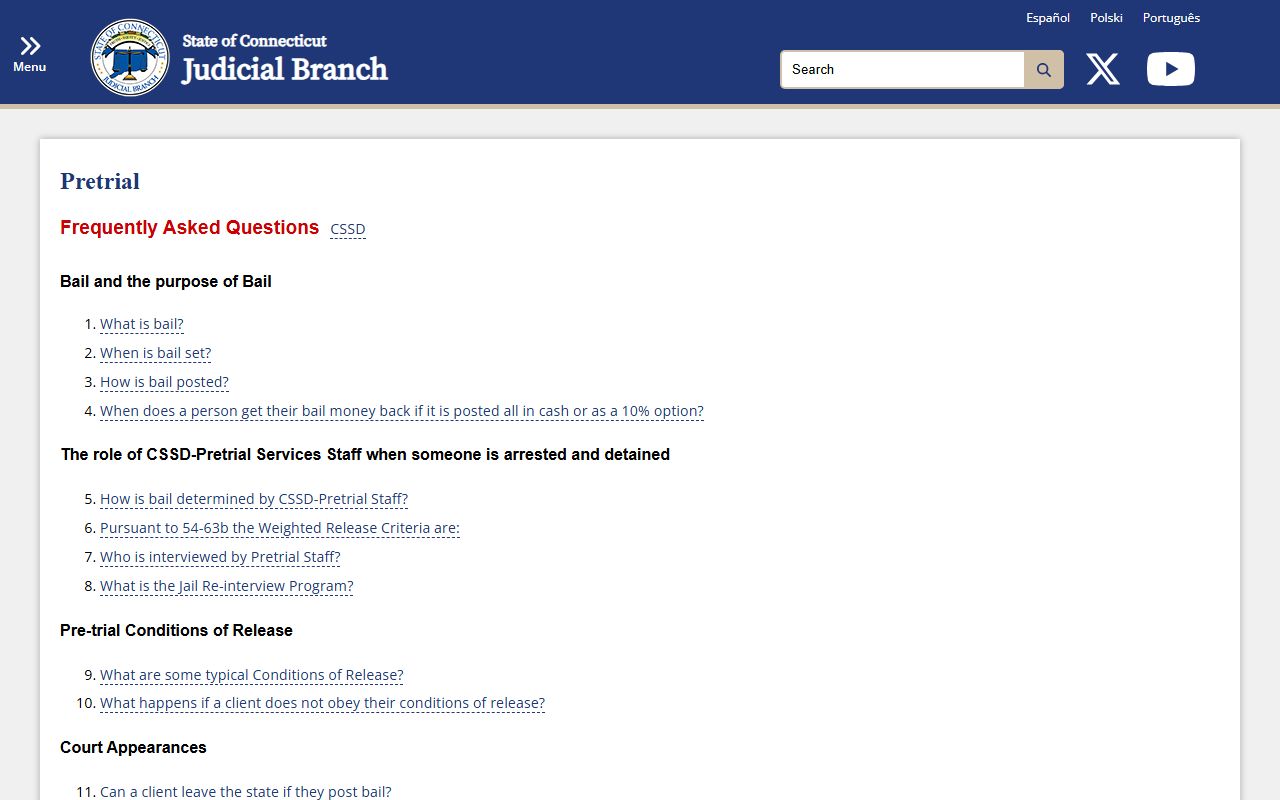
Payment methods vary by case and channel, so confirm accepted forms and exact posting steps with the holding agency or court before you travel. Do not assume online bond payment is available for a given case.
The Prosecutor's Role in Hartford Judicial District
The prosecutor controls the charges that become the court record. In Connecticut, that prosecutor is a State's Attorney, not a county district attorney. East Hartford falls in the Office of the State's Attorney, Judicial District of Hartford, led by State's Attorney Sharmese L. Walcott. The office sits at 101 Lafayette Street, Hartford, CT 06106, and its main line is (860) 566-3190. The Division of Criminal Justice handles the investigation and prosecution of all criminal matters in Connecticut.
This office decides what to file after an East Hartford arrest. Police list arrest charges. The State's Attorney reviews the file and may file formal charges that differ, then may amend, substitute, reduce, dismiss, nolle, or carry a charge to conviction. The Hartford office handles the serious class A and class B felony matters in Part A, while the GA and Part B courts take lower-level felonies, misdemeanors, infractions, and motor-vehicle offenses.
The Hartford Judicial District State's Attorney page lists the office contacts and the towns it covers, shown below.
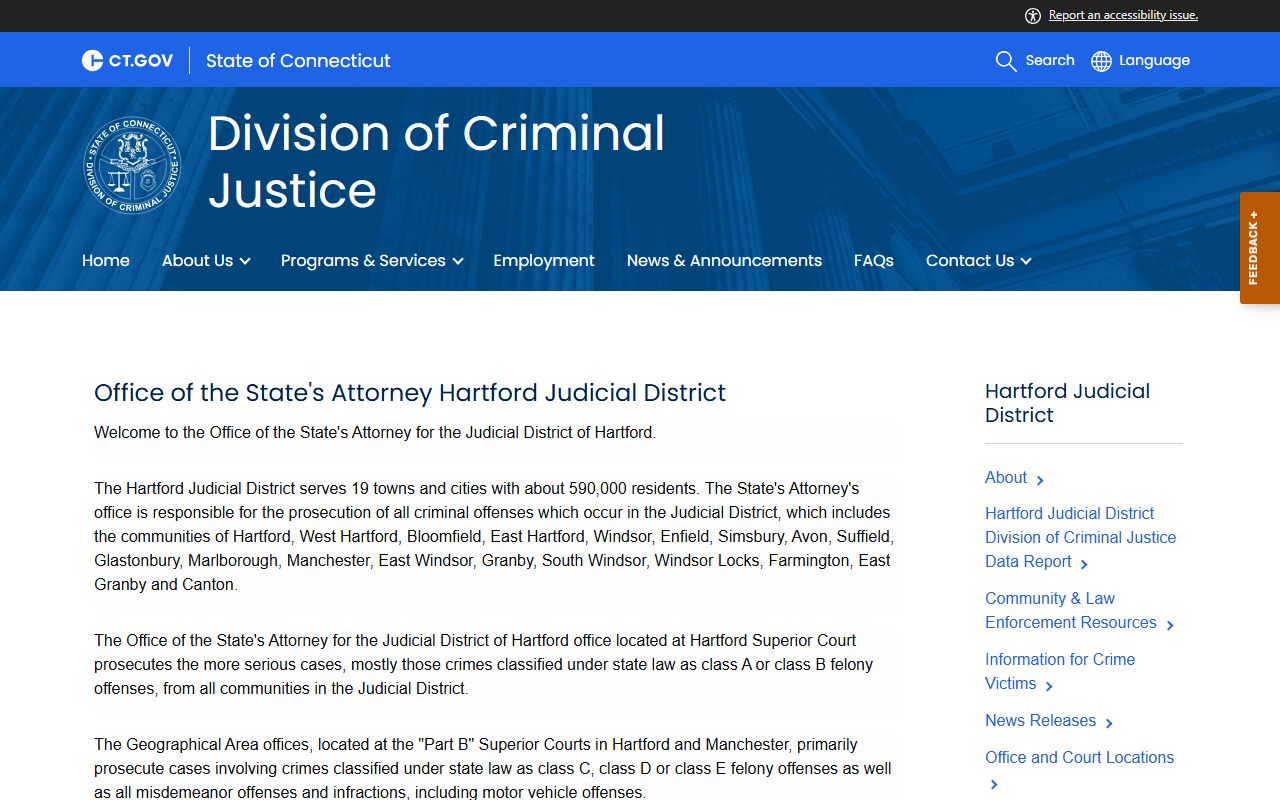
Because the prosecutor sets the charges, the court lookup, not the arrest log, is the place to confirm what a person actually faces.
Warrants, FTA, and VOP Cases
Some arrests start with a warrant, and a narrow warrant lookup exists for the public. East Hartford Police link to the Judicial Branch warrant search for violation of probation, failure to appear, and orders to incarcerate. Failure to appear, or FTA, means missing a court date. Violation of probation, or VOP, means an alleged breach of probation terms. An order to incarcerate is a court direction to take the person into custody.
The warrant lookup is honest about its limits, and so should any reader be. It does not list every warrant. Sealed warrants, ordinary arrest warrants, search warrants, and youthful-offender matters may not appear at all. The Judicial Branch warrant lookup uses the fields below.
| Field | Type | Notes |
|---|---|---|
| Last Name | Text | At least the first two letters; up to 30 characters. |
| Town | Dropdown | Statewide list that includes East Hartford, Hartford, and Manchester. |
| Court Location | Dropdown | Includes Manchester GA 12, Hartford GA 14, Hartford Community Court, and Hartford JD. |
| Search | Button | Search by any combination of name, town, and court location. |
Once a warrant is executed, the person can show up in the police arrest log, a pending court case, and, if held, CT DOC custody. The warrant search only covers the listed warrant types, so a clear result there does not mean no warrant exists.
Important: The warrant page warns users not to act against anyone based on its listings; call 911 or local police if there is an immediate threat.
Charges vs Convictions in Court Records
Being arrested and charged is not the same as being convicted. A charge is an accusation. A conviction is a finding of guilt by plea or verdict. Court records after an arrest can show open charges that never lead to a conviction. CT DOC makes the same point about custody, noting that a person held on accused status has not been convicted in that case.
| Charge | Conviction | |
|---|---|---|
| Stage | Accusation by the prosecutor | Guilty plea or guilty finding |
| Burden of Proof | Probable cause | Beyond a reasonable doubt |
| Where It Shows | Pending case search | Conviction search |
| Display Limit | Shown while the case is open | Up to 10 years after sentencing per Practice Book section 7-13 |
The two records sit behind two different search forms for a reason. Open charges run through the pending case search, and decided cases run through the conviction search. Reading a charge as a conviction is a common and costly mistake. Check the status on the record before drawing any conclusion.
Criminal History Requests Through CCHRS
For an official criminal history, Connecticut uses a separate paid channel from the free court lookup. The Connecticut Criminal History Request System, or CCHRS, is run by the state police side at DESPP, not the courts. It answers "what is this person's record," while the Judicial Branch lookup answers "what is happening with this case." The two tools serve different questions and should not be confused.
The public CCHRS path uses a name and date of birth. The requester fills in identity and contact details, then pays by card before the search runs. A few rules are easy to trip over. The report returns Connecticut information only. Results can change daily due to erasures, corrections, and pardons. A name-and-date-of-birth search can produce false positives and false negatives. Report access is one-time only, and opening it on a mobile device counts as that one access, since mobile is not supported.
Use CCHRS when you need a formal criminal-history report. Use the free Judicial Branch lookup when you only need to track the charges and status on a current court case after an East Hartford arrest.
Erased and Restricted Court Records
Connecticut does not use the generic "sealed versus expunged" labels. It uses erasure. Under CGS section 54-142a, qualifying criminal records are erased after outcomes such as a dismissal, an acquittal, certain nolles, or a pardon. Erasure is the state's main process for removing a record from public view. The court lookup applies these rules as cases resolve, which is part of why the displayed data can change daily.
The comparison below shows how erasure differs from the older sealed-versus-destroyed framing many readers expect.
| Erased Record (CGS 54-142a) | Display-Limited Conviction | |
|---|---|---|
| Trigger | Dismissal, acquittal, qualifying nolle, or pardon | Time since sentencing |
| Public View | Removed from public access under the statute | Drops off after the Practice Book display window |
| Effect | Treated as if the charge had not occurred for many purposes | Conviction may still exist with the court after it leaves the public display |
Some records never display at all. Juvenile matters and youthful offender cases are kept out of the public court lookup, and the warrant search hides youthful-offender warrants. Ongoing or sealed material can also be withheld. So an empty search is not proof of a clean history. The record may simply be erased, restricted, or held outside public view.
Important: This site is not a consumer reporting agency under the FCRA, and its information may not be used for credit, employment, tenant, or insurance screening.